
Week 2025-47

Google unveiled Gemini 3 Pro, Antigravity, and Nano Banana Pro. @vlkodotnet
This Week’s Highlight: Gemini 3, Antigravity, Nano Banana Pro
Google surprised everyone this week by announcing the new Gemini 3 model, their own agentic IDE called Antigravity, and on top of that, the Nano Banana Pro image generator. The only thing missing for complete dominance would be a new Gemma 4 model—that would absolutely steamroll the competition.
Let’s go through them one by one. The new Gemini 3 is currently only available in the Pro version, but anyone who’s tried it doesn’t want to go back. It’s exactly the model you need for most tasks. It doesn’t feel pushy like GPT, and the responses are to the point. It also excels at visualizing its answers.

If you’re not sure what “visualizing” means in this context, you can check out the examples here.

Along with Gemini 3 Pro, Google also released a new IDE designed for controlled vibe coding. What does controlled vibe coding look like? Instead of having a prompt generate code directly, there’s a planning phase first. Gemini 3 Pro thinks through whether your requirements are sufficient, asks follow-up questions, and creates a plan. You then review and comment on that plan. Based on it, a task list is generated. Once the plan is finalized, you kick off the second phase: task execution. Each task runs in its own session, preventing hallucinations from creeping in. When the tasks are complete, you get a walkthrough summarizing everything that was done. If you’re building a web app, you even get a final screenshot. You can also run multiple processes like this simultaneously.

In the three years since GPT-3 was released, we’ve come a long way. Today, I can much better imagine using agents in an IDE than I could at the beginning of this year. Besides AI video, this year has also been the year of agents. For now, it’s mostly just for us developers, since we know it’ll never be fully automatic—but it will still change how we work.

I wouldn’t want to be in Anthropic’s or OpenAI’s shoes right now. At 200k tokens, Gemini 3 Pro is currently cheaper. Plus, there’s the new Nano Banana Pro model, which handles images and text better than any model before it. Unfortunately, you can’t test it for free, but I did it for you—and it’s the first model that nailed my “well in that case” visualization on the first try.


Even Sundar Pichai is warning that the current AI investment boom is somewhat irrational. If the bubble burst, it would certainly hit Google too. But the products they announced this week aren’t exactly helping calm things down.

Dependency Cooldown
Lately, we’ve been hearing about supply chain attacks—cases where a hacker compromises a library you’re using and publishes an infected version. These are usually caught quickly, but there’s always a risk that your CI/CD pipeline runs at exactly the wrong moment, potentially exposing your API keys or data. There’s a simple technique called Dependency Cooldown that doesn’t install the latest version of a library, but rather a version that’s 7 to 14 days old. You might miss a zero-day patch this way, but that’s what dependency monitoring is for.

BIZ Insights
The EU announced new proposals regarding Cookies, GDPR, the AI Act, and cybersecurity. Among other changes, cookie consent can now accept browser settings, and cookies for “non-risk” purposes won’t require a pop-up.

Zoox, an Amazon-owned company, is launching public rides in San Francisco. It’s the second company after Waymo to operate self-driving taxis on city streets. Unlike Waymo, Zoox doesn’t use regular cars with added sensors—they’ve designed a purpose-built vehicle.

According to a recent survey, 9% of adults in the UK have watched illegal sports streams in the past six months. There are even special TV sticks sold for this purpose. Obviously, users are exposing themselves to risk. By the way, have you noticed that almost every sport now requires some form of separate subscription? Wasn’t streaming supposed to make this kind of entertainment cheaper?

It didn’t take long for Qualcomm to have lawyers draft new terms and privacy policies for Arduino, the company they acquired. And it turned out exactly how you’d expect from a corporation—badly for the open-source community.

In the US, a new bill called the “Algorithm Accountability Act” has been introduced. It would amend Section 230 of the Communications Act to hold platforms liable for foreseeable harms caused by recommendation algorithms. This is the very section social networks have been hiding behind, claiming they’re not responsible for anything. The law would only apply to algorithmic feeds.

Incidentally, increased investment in AI data centers has caused a shortage of DRAM memory on the market. In November alone, prices jumped 60%. We’ll probably see similar behavior in the hard drive market. Stock up while you can.

AI Insights
Let’s start today with new AI model announcements. First up is SAM 3D from Meta, which can create 3D reconstructions of objects from images.

To avoid looking bad compared to Gemini 3 Pro, OpenAI released the new GPT 5.1 Codex Max model.

If you care about having an AI model that’s as open-source as possible, Olmo 3 is exactly that. It doesn’t just release the weights—it also shares the training process, datasets, and dependencies. That’s useful if you want to customize the model.

Reddit citations in ChatGPT dropped from 60% to 10%, and Wikipedia from 55% to 20%. There are several theories why. One possibility is that Google removed the num parameter from search, so it now returns only 10 results. Another theory is that OpenAI is defending against manipulation, since these sources were being given too much weight.

The following link slipped through my list last week. Researchers managed to remove memory from AI models, isolating pure reasoning. This is useful when you want to process input without memory data influencing it.

.NET Corner
Upgrading to a new version has never been easier—GitHub Copilot has become the latest .NET application modernizer.

.NET 10 didn’t just bring C# 14 features. F# also got updates with the new version 10. I won’t pretend I understand them all, but here’s the link.

Visual Studio 2026 got a dedicated Copilot for testing. It does exactly what the name suggests: AI-generated tests. Let’s be honest—not everyone’s eager to write them.

DiagnosticSuppressor can help you get rid of annoying warnings that you know you can’t fix or that are unnecessary.

Link Drop
Google released its list of the best Android apps and games for 2025.

Apple released the same kind of ranking. Use both for inspiration on new apps to try.

Google Calendar can finally block time for tasks.

Google is bringing AirDrop to the Android ecosystem. For now, it’s only for Google Pixel 10 phones, but hopefully it’ll expand to everyone eventually.

Red Alert 2 in your browser.

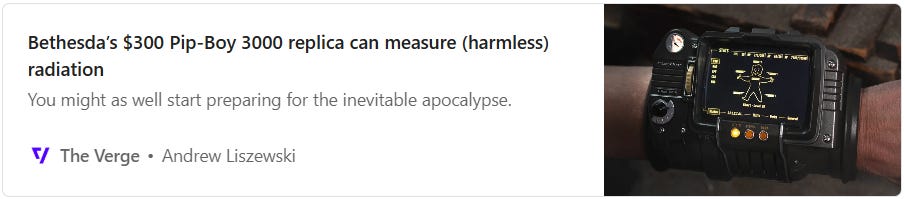
Bethesda is releasing a Pip-Boy 3000 replica for Fallout fans at $300. It has an LCD display with knob and dial controls. Instead of a Geiger counter, it measures FM radio signal strength. Now I just need to figure out how to explain to my wife why we need this.
A guide on how to build a synthesizer for kids. According to the instructions, you should be able to make it yourself. But if not, a Kickstarter version might be available.

Closing Visual
The Egg - a short story by Andy Weir.
