
Week 2026-01

The new year 2026 is here, and with it comes the traditional CES 2026 expo. @vlkodotnet
Week’s Highlight: CES 2026
This week isn’t about deep thoughts—it’s about a flood of new gadgets. CES showcases everything companies plan to bring to market in the coming year.
Nvidia kicked things off by unveiling their new Vera Rubin architecture, which delivers AI model computation 10 times faster at the same power consumption as its predecessor. They also announced technical and software solutions for autonomous driving, improved DLSS technology, and G-SYNC Pulsar, which uses a light sensor on your monitor.

Intel introduced Panther Lake processors, manufactured in-house using their 18A process. This architecture might finally let them leapfrog AMD in performance, but we’ll only know for sure once real benchmarks come out. These chips are primarily targeting laptops.

AMD settled for a platform refresh, so expect higher clock speeds. They did boost integrated graphics performance, though.

Qualcomm made the biggest push by the numbers, announcing the new Snapdragon X2 Plus series. These processors share the same NPU as the existing X2 Elite lineup but target the mass market—laptops that will compete with AMD and Intel on price while offering higher theoretical performance and lower power consumption. Single-core performance jumps up to 35% over the previous generation.

Lego unveiled SmartBrick, potentially their biggest revolution in years. It’s a simple 2x4 brick packed with technology that transforms finished models from shelf decorations into interactive experiences. Models can produce sounds, detect the position of other SmartBricks, and let you stage naval and space battles. Or simply track when cargo has been unloaded from your train.

Monitors had a strong showing this year. 5K and 6K displays are hitting the market. OLED monitors will offer RGB pixel layouts for sharper text rendering (personally, I find non RGB hard on the eyes). There are even monitors with 1000 Hz refresh rates.

Dell is returning their XPS line to what actually worked, and it looks like a seriously impressive thin-and-light with high performance.

The Legion Pro Rollable gaming laptop has a screen that doesn’t extend upward—it rolls out sideways. A 16-inch display instantly becomes a 24-inch screen at the press of a button.

Corsair introduced the Galleon 100 SD keyboard with a built-in Stream Deck Plus and a 5-inch display. It features quality MLX Pulse switches and two configurable rotary dials.

Keychron’s Nape Pro is a trackball designed to sit alongside your keyboard, letting you move the cursor without lifting your fingers from the keys.

Introcuit’s Magic Screen turns your MacBook into a touchscreen with pen support. The downside? The design prevents you from closing the laptop, so you have to reattach it every time.

Ikea’s Kallsup speakers are €8 mini speakers you can daisy-chain up to 100 units.

Roborock unveiled Rover, a robot vacuum with two little legs that let it climb stairs to reach other floors—vacuuming the stairs along the way. It’s still just a prototype, but I hope the final price ends up cheaper than buying a separate robot vacuum for each floor.

If you want more, here’s a roundup of smart home devices

And here’s a list of AI-enhanced gadgets—though “enhanced” doesn’t always mean “useful.”

Finally, the best stuff from CES. You’ll notice the only overlap between my interests and theirs is that stair-climbing robot vacuum.

BIZ Insights
Tailwind announced they had to lay off 75% of their engineering team because everyone was using the framework through vibe coding, and their business model relied on converting users to paid products through documentation. Come to think of it—how many vibe coders even know whether they’re using Tailwind?

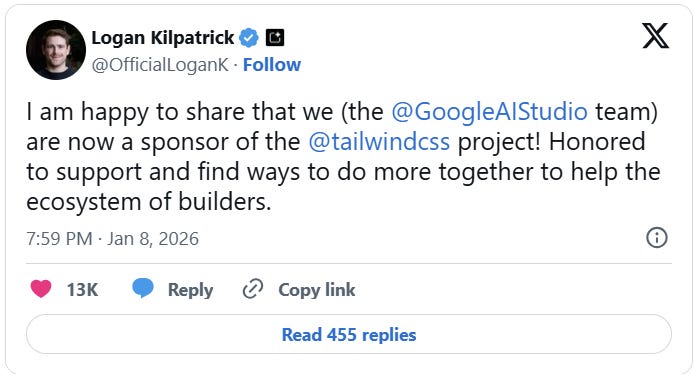
Fortunately, someone at Google grew a conscience, and Google AI Studio became their official partner.
Meanwhile, AWS quietly raised GPU instance prices by 15% because demand is outpacing supply.

SteamOS added support for more devices and is betting on the future of ARM chips.

AI Insights
Products that fork VSCode don’t have access to official VSCode extensions, which is why the OpenVSX registry exists. Sometimes, though, a recommended extension isn’t available there—creating an opening for attacks. Be careful what extensions you install in Cursor or Antigravity.

AI Overviews have made their way into Gmail.

A Microsoft engineer wrote a recruiting post on LinkedIn about their experiments converting C++ code to Rust using AI. The internet immediately concluded that Windows is being rewritten in Rust with AI. The engineer had to clarify that’s not what’s happening.

This one’s for people who like repetitive music to help them focus. Focusmusic is a console app built exactly for that purpose. No annoying UI—just the command line.

Toasty is a simple hook for Claude Code, Gemini CLI, or GitHub Copilot that shows a Windows notification when an agent finishes a task in your console.

Links Drop
How was 2025 for databases? PostgreSQL cemented its dominance, MCP for databases emerged, and MongoDB Inc. sued FerretDB Inc.

Bose ended support for their decade-old SoundTouch product. Instead of leaving customers stranded, they took the bold step of open-sourcing the API used to control it. Which means, of course, that picking one up on eBay is now worth it for people like us.

Enclose.horse is a simple relaxing game where you can kill a ton of time. New levels are added regularly.

Visual Closing
When people ask how my Christmas went.
