
Week 2026-06 and 07

I took a bit of a break last week, so today you're getting a double dose of information. @vlkodotnet
Two-Week Reflection: Where Is All the AI-Generated Software?
When you have a week off, aside from trying to unplug, you also have more time to think. It’s no coincidence that the last three months have been pretty lively around AI agents that generate usable code.
How would I start this topic? Probably with advice on how you should start. Jumping into AI-assisted programming isn’t something you just decide to do one day. As my colleague Miro says (by the way, he does most of our AI research, and I’m kicking myself for not talking about it more), it’s like learning to play guitar. It takes a while before your playing sounds any good.

Then you start using AI agents and discover that AI handles work you wouldn’t have expected. This isn’t something coming in a few years. AI agents can be useful here and now. Something “big” has happened. You might not like it, but you can’t ignore it.

Over time, though, you realize you don’t want to just sit at your computer waiting for the agent’s results so you can react. That’s where the next level of working with agents comes in — orchestration. Whether you choose Ralph’s Loop or a more complex system with different tiers of AI agents that cross-check each other and pass work around, you essentially build your own virtual team and realize that code is just a commodity, but functionality is what matters. Then it’s up to you what quality of output you’re willing to accept. Right now, that means how much time you want to spend stepping into this virtual team and reviewing what it produces. Naturally, more is better. The following article describes this process well.

But be careful — you can get completely sucked in. It’s like playing video games: let me just spec out this one more thing... let me have it build that... I wonder how it’ll handle this... wait, it’s 2 AM already?
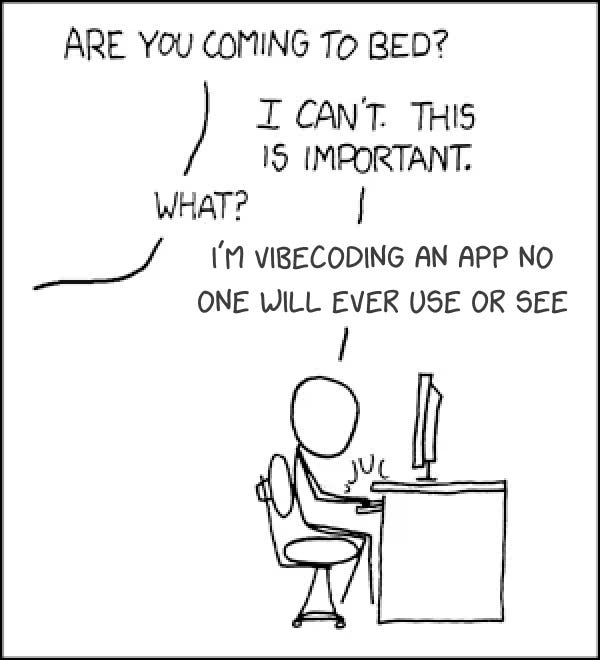
One thing is interesting though. If all of this is true, where is all the code generated by AI agents? I have two theories.
The first is that we’re in a phase of rapid internal tooling development. Billions of tokens are being burned to create orchestration frameworks, with everyone trying to build the “one true system” for AI agent collaboration. If you don’t have your own, you basically don’t exist. Once you’re happy with that, you start building every tool your company ever planned but never had time to create. At this point, most AI enthusiasts will probably disagree with me, but the following article about “Tool-Shaped Objects” describes it beautifully — things that look like tools, feel like tools, but don’t produce real work.

Which brings me smoothly to my second theory. The phase where real applications built by AI agents and their orchestration systems actually arrive is still ahead of us. The real problem is that you can use the best model available and have dozens of differently configured AI agents. But if you don’t have meaningful work for them, you’re left generating useless things. No matter how sophisticated they look, their business value will be low. The change came too fast, and your company simply can’t test, process, and ultimately sell everything that AI agentic systems can generate. There’s only one logical consequence: we ourselves need to get more involved in product processes — more meetings, more requirements analysis, more... more becoming something other than just a developer.
I should wrap up this reflection somehow. And naturally, with a link to an article describing what a company that benefits most from agentic development should look like. In short: “more work than people.”

Google Code Wiki
There’s nothing worse than a project without good documentation. And it’s also true that this is something we developers aren’t great at. Google has created a project that takes your open-source repository’s code and generates documentation that stays current and references actual parts of the code. I’m not entirely sure this is the best approach, but it could be a revolution that makes some projects accessible to a wider audience... of AI agents?

Security Insights
It’s hardly surprising that Chrome extensions sometimes do more than they should. Fortunately, someone put in the effort to test them and found 287 extensions with a combined 37.4 million installs. Check whether any of yours are on the list.

Anthropic’s red team published a report on how hackers can use AI to generate zero-day vulnerabilities.

Two weeks later, Anthropic introduced a new project called Claude Code Security aimed at detecting exactly these kinds of vulnerabilities.

I hesitated about whether this topic fits in this section. But you should know that even major players like Google, OpenAI, and Anthropic struggle with data theft. And not just any data. It’s called a model-extraction attack, and its goal is to teach your own AI model reasoning by analyzing the reasoning of a better AI model.

OpenAI directly points to Chinese models as the culprits.

BIZ Insights
Google sued web scraper SerpApi for scraping the results of their scraper. Does that sentence sound weird? The gist is that Google can scrape the entire web, but nobody can scrape Google.

The EU has started requiring companies like TikTok to comply with DSA regulations. One of these says they shouldn’t use addictive design — which is exactly what infinite scrolling of short videos is.

Staying with the EU — the president of the European Central Bank announced that Europe will build its own instant payment system to break Visa and Mastercard’s monopoly.

AI Insights
How else to start the AI section than with the story of an AI agent that, after a matplotlib repository maintainer rejected its pull request, wrote a hit piece blog post about them. It later turned out this agent had been running for 58 hours straight. That’s the world we’re heading toward.

OpenClaw author Peter Steinberger got acqui-hired by OpenAI, where he’ll build similarly innovative products. Since he was OpenClaw’s biggest contributor, the project’s future direction is uncertain.

OpenAI definitely needs to bring something new to the table, because Anthropic and Google are breathing down its neck.

Sonnet 4.6 shipped, and it’s another step up — though reports suggest that while it’s cheaper, it can burn significantly more tokens than Opus 4.6 on some tasks. So for now, Opus 4.6 still leads.

OpenAI promptly responded with the new GPT-5.3-Codex-Spark, running on specialized hardware capable of generating over 1,000 tokens per second.

China wasn’t about to be outdone either, releasing GLM-5, which competes on price and reportedly delivers solid results. You can even run it on reasonably good hardware at home.

Alibaba released its AI answer, Qwen Image 2.0, to compete with Google 3 Banana Pro. The model is only available within their app.

And also Qwen 3.5 — a newer, better model that’s much easier to run on your own hardware.

You know what TikTok does with all those videos you upload? Trains one of the best AI video generation models. Seedance 2.0.

There are way too many models these days, but we can’t forget Google, which released Gemini 3.1 Pro — which is, well, Pro.

If OpenClaw feels too wild for you, maybe try LocalGPT. By the way, a whole bunch of OpenClaw clones have popped up recently. We’ll see which ones survive the test of time.

.NET Insights
It’s been a while since we had this section. So I’m happy to announce .NET 11 — in Preview 1. Highlights include a new async runtime that helps with complex async scenarios, new collection expressions, and in ASP.NET Core it’s all about Blazor updates.

A modern reactive terminal UI framework, because in the age of Claude Code, we’re not ashamed to build console apps.

For everyone who’s ever thought “a keyboard shortcut would be faster than clicking through Visual Studio menus” — there’s the Keyboard Hero extension. It tracks your click history and suggests keyboard shortcuts in a dedicated window.

Links Drop
Ayaneo Next II is the ultimate portable gaming device, available in configurations ranging from $2,000 to $4,300.

Google Pixel 10a continues the 9a line, bringing a better display, improved drop resistance, and satellite SOS — but nothing else. No new processor, no more RAM.

Microsoft announced Store CLI — a command-line interface for installing and managing apps from the Microsoft Store.

AppControl is a kind of Task Manager replacement — well, not exactly. It shows you which app requested permissions and when it launched. I’ve been running it for half a day and discovered how much Asus bloatware is running on my machine. Definitely worth installing, at least to try.

Oat is an ultra-lightweight UI library for when you don’t need much CSS and JS.

Did you know there’s an open-source operating system called AsteroidOS for some types of smartwatches?

To conclude this extensive newsletter with a touch of whimsy — enjoy this selection of AI-generated ads from this year’s Super Bowl.

Closing Visual
At the end of the day, we’re still human.
