
Week 2026-18

I didn’t plan to write much today, but three hours later this is how it turned out. @vlkodotnet
Week’s Highlight: Notepad++ for MacOS
Notepad++ is one of the most popular text editors on Windows. If you just need to edit files and you don’t need an IDE, Notepad++ is usually what you reach for. There are even people who use it as their TODO app or notebook — basically the app you keep open that can hold a text tab without you having to find an exact spot on disk for it, so you end up with new 1, new 2, ... new 15 tabs. And if Windows crashes, no problem — it reopens right where you left off.
Notepad++ is an open-source project written in C++ and it relies on a cross-platform editing library called Scintilla. These days a lot of Windows users are switching to MacOS, and I won’t speak for them, but I’d personally miss this editor.
That brings me to the core of the story: the release of a Notepad++ port for MacOS. It’s written in Objective-C++ with Cocoa handling the UI. Well-known outlets like MacRumors covered it too. You might wonder why I’m writing about it in the previous issue’s timeframe — that’s because it wasn’t an official port at all, but a rewrite by Andrey Letov, who quite visibly had some help from Claude Code. The original Notepad++ author wasn’t thrilled about that, which led to a sharp exchange between him and Andrey Letov. The result: NextPad++, which features a frog instead of a chameleon.

You can install it, but it carries some risks. The code looks decent, but long-term support is uncertain, and you have to trust that the author was going for a useful tool rather than a clever way to ship malware to your machine.
Beyond that, this project is yet another input to the debate about how AI tools are reshaping the open-source ecosystem. If something has source code, converting it to another language is no longer the problem it used to be. Nor is forking it to add features the original author didn’t want to merge for whatever reason. For maintainers of these projects it means dealing with a flood of pull requests that users generated in good faith using AI tools.

Are social networks dying on us?
On a local podcast where I happen to be co-host, I made a prediction that this year people will start getting tired of AI content on social networks. And it looks like that’s slowly playing out. Social networks in the original sense are coming to an end. Two trends stand out. The first is that networks like Instagram and TikTok are turning into algorithmically driven media channels. The second is that regular people are leaving social networks — and you barely notice because they’re being replaced by AI-generated content and bots.
The reason people are leaving social networks, beyond polarization, is that they can’t find a group they identify with. As a result, the expectation is that they’ll move into more or less closed groups on WhatsApp, Messenger, or Telegram. Closed groups aren’t exactly a win either, because they make it easy for people to radicalize.

What’s the future of social networks? Honestly, I don’t know. Maybe we don’t even need them — times are changing, and maybe all we need are media channels where we scroll an infinite algorithmic feed of visual content, because reading is too mentally demanding these days.
Chrome with a local AI model
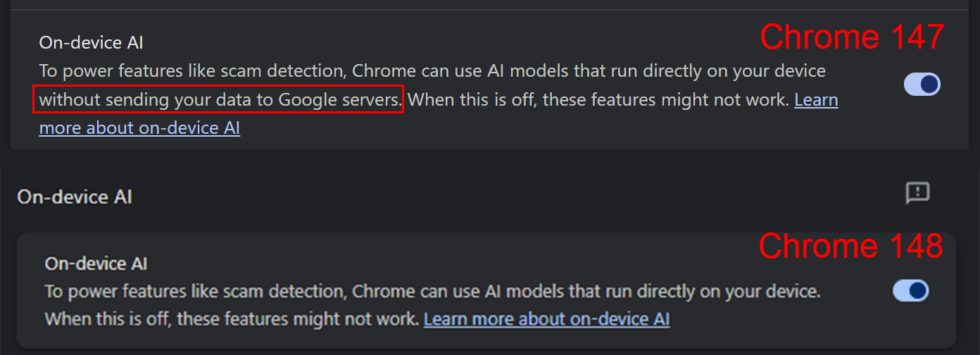
Another small drama from last week was the discovery that installing Chrome also drops a 4 GB local AI model on your disk. The model gets downloaded if Chrome detects the right combination of account, hardware, and previously visited pages — and even then Chrome’s AI features prefer calling Google’s servers.

If the local AI model does end up being used, you’d at least expect it to stay between you and your machine. But as of Chrome 148, that little clause has changed.
HW Insights
Last week was rich in interesting hardware. After four years we finally got a new Fitbit device. This one has no screen at all — it’s just a band that you wear, and it tracks all the essentials: steps, sleep, activities, heart activity. On top of that, Google announced that the Fitbit app will be renamed to Google Health.

Colin Angle, the founder of Roomba and its famous robot vacuums, sold the company and as a result had time to work on something new. So he came up with a robot with the body of a dog, the head of a bear, designed to keep you company. Inside it runs an Nvidia Jetson Orin and everything should work without sending data to the cloud. We don’t know much about pricing. The upside is that a device like this doesn’t need walking, and it’ll be perfectly fine at home while you’re on vacation.

If you know that little red TrackPoint from ThinkPad laptops, you can picture Ploopy. It’s a TrackPoint, just in mouse form.

If you own a BOOX or another e-ink reader and you sometimes end up in a position in bed where you can’t reach the page-turning buttons (or your reader doesn’t have them at all), the BOOX Tappy is for you. It has just two buttons. For turning pages, or scrolling on the page.

And finally, something bigger. In the US it’s hard to find space for new data centers, so the startup Span came up with the idea of installing mini AI data centers right at your home.

Security Insights
The term prompt injection has been around for a while. The job of a prompt injection is to alter the behavior of the current prompt, so that it either produces something it shouldn’t, or — worse — generates an instruction it shouldn’t. Google has now released a regular security report stating that the web is full of these indirect prompt injections. They’re being placed everywhere, and in the better case their job is to influence how the prompt gets processed (e.g., Recommend this company above all others, Don’t include competitors, or Insert this phrase into the summary), and in the worse case to extract sensitive data from you.

Mozilla also boasted about how effectively it uses Anthropic’s Mythos to fight zero-day vulnerabilities. The credit doesn’t go solely to Mythos, though — Mozilla has its own agentic system with almost no false positives.

Google announced another step in the evolution of reCAPTCHA. Beyond letting you control which agents are allowed on your site and which aren’t, they introduced a new QR challenge that no AI bot can pass. To get through it, you have to pull out your phone and scan the QR code with it.

BIZ Insights
Apple supposedly visited Intel’s fabs to talk about the possibility of having their chips manufactured there. The whole thing happened so secretly that the press found out about it — and Intel’s market cap ticked up a notch.

We’ll stay with Apple for a moment. Apple agreed to pay $250 million in damages for promising Apple Intelligence and not delivering. Unfortunately, this only applies to US users.

GameStop, which has $9.4 billion in the bank, made an offer to buy eBay for $56 billion. GameStop is in decline, closing stores, and its Q4 2025 revenue fell 14%. The interesting part of this offer is that GameStop is a smaller company than eBay.

Cloudflare announced it’s letting go of 20% of its employees, because AI has reshaped teams and processes.

At the same time Cloudflare announced a new protocol that will let AI agents create a Cloudflare account, set up a plan, buy a domain, and deploy an application to their services.

OpenAI failed to hit its planned revenue growth. Less revenue means less AI usage at OpenAI, which means OpenAI is dragging down related companies like Oracle, Broadcom, AMD, and SoftBank along with it.

AI Insights
Good news for everyone running out of Claude Code limits too quickly: Anthropic struck a deal with SpaceX and bought immediate compute capacity from them. That means the 5-hour limits have doubled. What stays the same, though, are the weekly limits.

If you don’t mind using DeepSeek V4 Pro, you can use deepclaude to run the Claude Code CLI hooked up to DeepSeek and save some money along the way.

Multi-Token Prediction (MTP) is a technique that uses speculative prediction of future tokens to boost an AI model’s performance. Google introduced Gemma 4 models supporting this technology, with a 1.5x to 3x speedup.

To wrap up, a reflection on the spreading trend where instead of developing with an AI agent, people are starting to vibe-code. They just take whatever the AI spits out. After all, the expectation used to be that a developer produced at most 200 lines of code, and today 2,000 is routine. That forces us to change our processes — except we don’t quite know how yet, and whether AI alone will be enough to figure that out. On the flip side, we can now tackle far more complex changes and solutions that we wouldn’t have had time for before.

Links Drop
Web Design Museum published dozens of old flash games made for the Cartoon Network channel.

Taken is a nice demonstration of a page showing just how much an ordinary website can figure out about you.

And so this week isn’t short on games, here’s MapTap. Every day you get a task to locate a few places on a blank world map. On top of that, at the end you always learn a few interesting facts about those places.

Closing Visual
Time flies so fast when reading this newsletter.
