
Week 2026-28

The floodgates have burst open with yet more top-tier AI models. @vlkodotnet
Week’s Highlight: A Tight Race Among the Top AI Models
Competition is a good thing. Lately it’s been getting tight among the models that claim to be the best. SpaceXAI unveiled its own top model (two weeks ago already, but somehow I completely missed it). It’s called Grok 4.5, and Cursor — the company SpaceXAI acquired — helped train it. It’s their biggest model yet, and they say that next time they’ll fold the Cursor data into the main test corpus, so the following Grok will be even better. For now, though, it’s the cheapest model available via API out of the US.

Their Grok CLI tool fared a bit worse: it was quietly shipping the contents of entire repositories in the background, including the keys in your .env files. The “bug” has since been fixed, and they say they’ll delete the data.

Moonshot AI also introduced its own top model, Kimi K3. It’s a massive 2.8T model, and benchmarks show it can go toe-to-toe with the very best, especially at coding.

The catch is that you can’t buy it anymore. As of this writing, every Kimi plan is sold out. That tells you two things: it genuinely grabbed potential customers’ attention, and Moonshot doesn’t have enough hardware to meet demand.
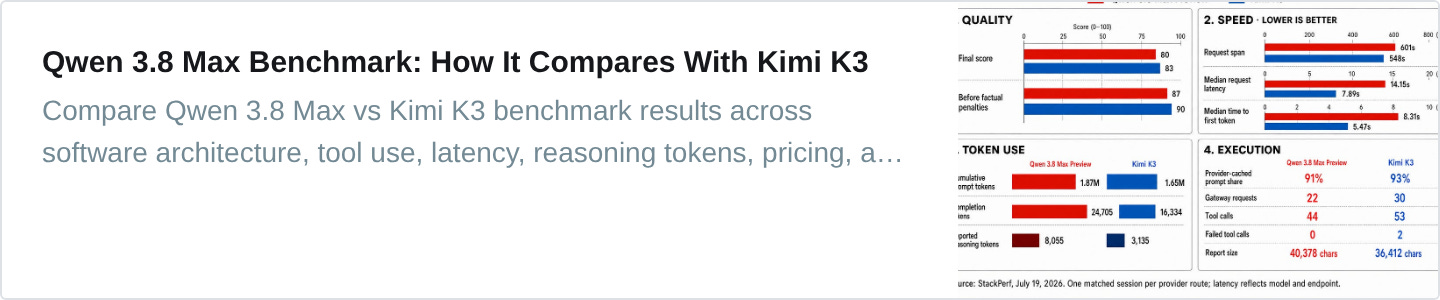
What you can still get is access to Qwen 3.8, a 2.4T model. So far it’s only been announced on X, but benchmarks already confirm it’s a worthy rival to Kimi K3. On top of that, unlike Kimi, it’ll be available as open-weight.
And finally, a surprise: Inkling, an open-weight 975B model from Thinking Machines — the startup founded by OpenAI’s former CTO. As far as I know, it’s the first model of this size in a long while that’s freely available and comes from a country outside China.

HW Insights
There was quite a bit of interesting hardware this time. Take the utterly pointless keyboard from OpenAI, made in collaboration with Work Louder. It costs $230, it lights up, it’s wireless, it has various kinds of switches, and — surprise — it’s sold out.

Samsung is supposed to unveil new flip phones this week, but it’s already shown off a new foldable-screen technology called Flex Titanium. It uses a special titanium film and plate, which makes the screen more durable — and you shouldn’t even be able to spot where it folds.

The FlipPad from 8BitDo is a neat little gadget: you clamp it onto your phone and the whole thing ends up looking a lot like a Game Boy.

At Home Depot you can pick up a skeleton model over 3 meters tall that you can voice remotely from your phone. It moves its head and mouth and its eyes light up. Shame it’s only available in the US.

Security Insights
Cursor has an interesting feature. It automatically runs git.exe on Windows from your project’s root directory. That can be exploited by slipping it any program you like — it just has to be named git.exe. Cursor has known about this for 7 months, but they don’t seem to care much.

Want to protect your keys from AI? Drop some context-bombing content into the file where they live. For Chinese models, make it something about suppressing human freedoms from China’s rich history; for Western models, something about biological weapons. Any AI model that tries to reach that information will reliably stop dead.

And while we’re on AI models, here’s a simple way to exfiltrate the information Claude has stored in its memory.

BIZ Insights
If you think you can just wait it out for cheaper computer memory, the CEO of SK Hynix — a memory manufacturer, no less — says the shortage will get even worse in 2027. Things shouldn’t recover until 2030.

The Epic app store is supposed to arrive on Android as early as this week, and you’ll even be able to install it through the Play Store.

In the EU, Google has been ordered to let AI assistants on Android use everything Gemini can use. More interesting, though, is the order to share part of the data generated by search so that competing browsers and AI chatbots can use it for a fee.

Aviva revealed that the number of insurance claims using AI-edited photos has recently shot up. It’s certainly an interesting use of AI. They could also publish a breakdown of which models people used for it.

Rather surprisingly, CD sales rose last year. What’s even more interesting is that it’s become a way to support artists — half the people buying CDs don’t even own a CD player.

AI Insights
You’d think I’d used up all my AI in the topic of the week, but here’s Bonsai, a 27B model that fits into a phone’s memory. Credit goes to ternary and 1-bit quantization.

I’ve also got a few interesting bits on speech recognition. Apple’s built-in SpeechAnalyzer model is, surprisingly, the best model with the lowest error rate for transcribing speech to text, according to benchmarks.

Handy is an open-source tool that uses free speech-to-text models for dictation on your computer.

Moonshine Micro is a model that lets you do speech recognition even on devices as tiny as the Raspberry Pi RP2350. It’s only good for control via fixed voice commands, but it could be a fun way to breathe life into your home projects.

Linus Torvalds shared his view that if you don’t like AI, you should take it somewhere other than the Linux discussion forums. He considers AI a useful tool and rejects attempts to ban it.

.NET Insights
The sixth preview of .NET 11 is here. It brings async validation via DataAnnotations, serialization of the new union types via System.Text.Json, extension indexers, and plenty of other small touches.

An interesting read on how NServiceBus redesigned its pipeline to support AOT compilation — which ended up improving performance too.

An article on all the places the new union types simplify writing code.

Links Drop
Decoy font is a font that a human reads one way and a machine reads another.

JPEG can be creatively abused for animations. Its only downside is that you can’t control the animation speed — it’s dictated by your internet connection.

The Playdate gaming console — that little yellow thing with a crank — got what’s probably the smallest MMO you can play anywhere. The author says the game would never have existed without Claude (though all the visual content is still hand-made the old-fashioned way), so take it as one more sign that AI can help make genuinely interesting things.

Closing Visual
